What does a commercial locksmith do for Toronto businesses?
Most business calls come down to three things: someone has a key they shouldn't, a door won't lock or close properly, or nobody can get in. The hardware is heavier than what's on a house, and more people carry keys, so small problems spread fast.
Here's what we handle for businesses and buildings:
- Lock changes and rekeys after a staff member leaves, a tenant moves out or a key goes missing. See lock change if your hardware is worn out.
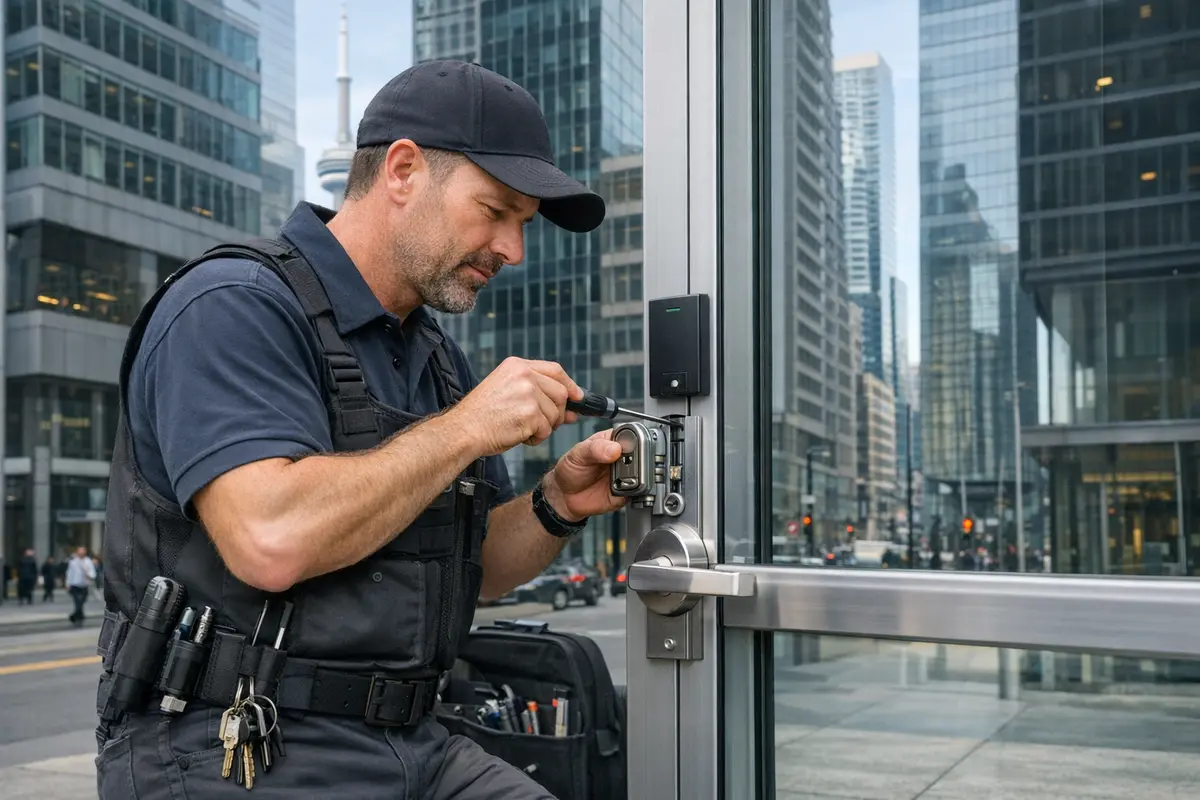
- Lock repair on commercial lever sets, mortise locks and the narrow deadbolts on aluminum and glass storefront doors
- Master key systems so managers carry one key and staff only open the doors they need
- Exit devices and door closers, including panic bars that stick, won't latch or need a key from outside
- Keypad and keyless entry for back doors, staff rooms and small offices
- Lockouts at a store, office or unit, once you show you're allowed in
- Restricted keys that can't be copied at a hardware store or key kiosk
Which commercial locksmith service do I need?
Find the line that sounds like your situation. Each page goes into the details.
| Your situation | What usually fixes it | Read more |
|---|---|---|
| An employee left and didn't return a key | Rekey the doors that key opened. On a master system, rekey under that master. | Master key systems |
| You manage a condo or rental building | Unit turnover rekeys, mailbox locks, common area doors and key control | Property managers |
| You're outside a locked store or office | Non-destructive entry first, then a new key or lock repair if needed | Office lockouts |
| The exit door bar sticks or won't latch | Adjust, repair or replace the exit device | Panic bars |
| Too many keys out there, or you want codes instead | Keypad lever, push-button lock or electric strike | Door hardware and access |
| Keys keep getting copied without permission | Restricted keyway or high-security cylinder | High-security keys |
Still not sure? Call and describe the door and what it's doing. That's usually enough for dispatch to tell you what's involved.
Not sure which service you need? Describe the problem and we'll tell you.
Call (647) 367-8113Do you work on storefront, office and warehouse doors?
Yes. Each type of building has its own usual hardware, and knowing what you have helps us bring the right parts the first time.
- Stores and restaurants: aluminum and glass doors with a narrow deadbolt or deadlatch and a round mortise cylinder. You see these on every main street, from Queen West to the Danforth. The cylinder can usually be rekeyed or swapped without replacing the whole lock.
- Offices: commercial lever sets from brands like Schlage, Sargent, Corbin Russwin and Yale, often on a building master key system.
- Warehouses and industrial units: steel doors in steel frames, heavy deadbolts, padlocks and hasps, and man doors beside overhead doors. Toronto has plenty of these in the industrial pockets of Etobicoke, North York and Scarborough.
- Condo and rental buildings: suite doors, mailbox locks, garbage and storage rooms, roof and mechanical room doors.
Before you call, take a photo of the lock face and the edge of the door where the latch is. If there's a brand name or number stamped on the cylinder or key, read it out to dispatch. It helps us show up with the right cylinder instead of making a second trip.
How much does a commercial lock change cost in Toronto?
We don't post flat prices because commercial jobs vary a lot. Dispatch gives you a price once we know the details, and it's confirmed before any work starts. There's no call-out fee.
What moves the price:
- How many cylinders there are, counting padlocks, mailbox and cabinet locks
- Rekeying the existing cylinders or replacing the lock hardware
- Standard keyways or restricted and high-security cylinders like Medeco, Mul-T-Lock or ASSA
- Whether the new keys have to fit an existing master key system
- How many keys you need cut
- Time of day, since work after closing or overnight can cost more
Rekeying is usually the cheaper route when the hardware is still in good shape. Our guide on rekeying vs replacing locks explains when each one makes sense.
Should I rekey or change the locks when an employee leaves?
If the person handed back their keys and left on good terms, plenty of owners leave the locks alone. If a key is missing, they left on bad terms, or you honestly don't know how many copies exist, rekey. Standard keys can be copied at any hardware store, so getting one key back doesn't prove there isn't another.
Rekeying changes the pins inside the cylinder so old keys stop working. You keep your locks, and it's quick per door. If keys go missing again and again, ask about a restricted keyway, where blanks are controlled and copies need your written approval.
Can you do the work after hours so we don't have to close?
Yes. Dispatch answers 24/7, and we can book work before you open, after you close or on a weekend. That's normal for restaurants and shops that can't have the front door apart during service. Urgent jobs, like a door that won't lock at closing time, get sent out right away. More on that on our after-hours locksmith page.
We cover the whole City of Toronto, from downtown office towers to Scarborough plazas and industrial units in North York and Etobicoke. For urgent calls, we usually arrive in about 15-30 minutes, though traffic, weather and time of day can add time.
What happens when you call?
Describe the building and the doors
Tell dispatch what kind of business it is, which doors are involved, how many locks, and whether you're on a master key system.
Get a price and pick a time
You hear the price before we book. We can come right away or schedule around your hours, including before opening or after close.
Authorization check on site
The technician confirms you're the owner, manager or an approved contact before changing or opening anything.
Work, test, hand over keys
We test every door with every new key, count the keys out to you, and give you a receipt for the job.
Page reviewed October 2026 by the LocksmithGT team.