
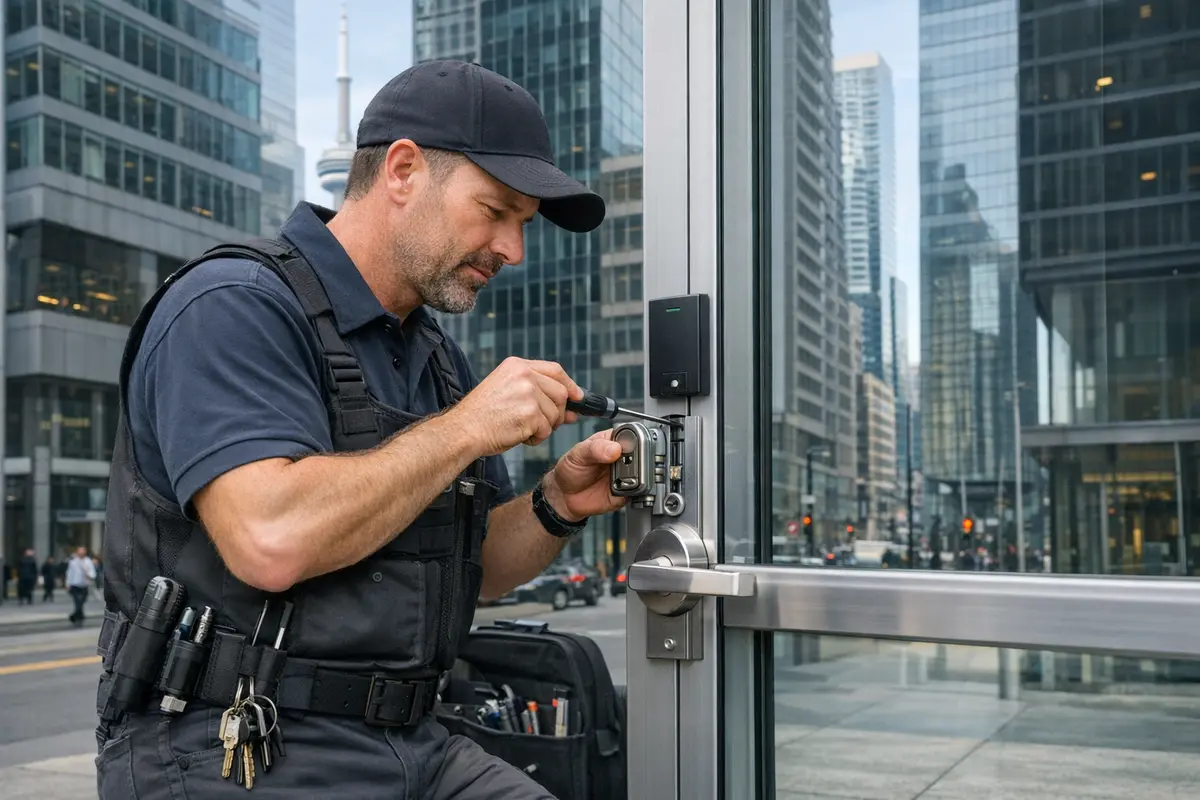
What is the simplest keyless entry for an office or store?
For one or two doors, a standalone keypad lock is usually enough. There's no wiring, and it replaces the regular lock on the same door.
| Option | How it works | Good for |
|---|---|---|
| Mechanical push-button lock (like Kaba Simplex, now dormakaba) | Buttons move parts inside the lock. No batteries, no wiring. | Staff rooms, back doors and stock rooms where the code should never go dead |
| Battery keypad lever (like Schlage or Alarm Lock Trilogy) | Electronic keypad with several user codes and a key override | Small offices that want one code per person and to delete it when someone leaves |
| Smart lock for an office | Keypad plus an app. Some keep an entry log. | Small teams that want to send codes remotely. Check it's rated for commercial traffic. |
| Electric strike with keypad or buzzer | Wired to power. Releases the latch when a code is entered or a button is pressed. | Reception doors and buzz-in entrances |
Change the code when staff leave, the same way you'd rekey. A code that five former employees know is no better than a lost key.
Electric strike or maglock: which do I need?
Both lock a door electrically, but they work very differently.
- Electric strike: replaces the strike plate in the door frame. The door keeps its normal latch and lever. When the strike gets a signal, it lets the latch swing free. A fail-secure strike stays locked from outside if power cuts out, while you can still leave with the inside lever. A fail-safe strike releases when power is lost.
- Maglock (electromagnetic lock): a magnet on the frame and a steel plate on the door. It only holds while it has power, so it lets go in a power failure. Because a badly wired maglock can trap people, one on an exit route needs a reliable way to release from inside and usually has to tie into the fire alarm.
For most Toronto offices and shops, an electric strike on the existing lockset is the simpler choice. Before adding a maglock to any exit door, check with the building owner and the fire inspector. We'll look at the door, the frame and where power can come from before recommending either one.
Need commercial door hardware & access now? A real person answers 24/7.
Call (647) 367-8113Do you install full access control systems with cards and software?
Systems with card or fob readers on many doors, networked controllers, software and user databases are often done with an access control specialist, especially in condos and larger offices that already have one. If your job needs that, we'll say so on the phone instead of guessing.
What we do on those doors is the locksmith side:
- Lever sets, mortise locks and cylinders, including the key override
- Electric strikes and cutting the frame to fit them
- Door closers, hinges and latching problems that stop the system from securing the door
- Exit devices on doors that are part of the system (see panic bar repair)
Why won't my commercial door close or latch properly?
It's usually the closer or the door alignment, not the lock. Match what you see:
| What you see | Likely cause | What we do |
|---|---|---|
| Door slams or swings shut too fast | Closer speed set wrong or valve worn | Adjust the closing and latch speed |
| Door stops just short and doesn't latch | Latch speed too slow, or latch hitting the strike | Adjust the closer and realign the strike |
| Oil on the closer or the floor under it | Closer seals have failed | Replace the closer. A leaking closer can't be fixed by adjusting it. |
| Door drags or only latches when you push it | Loose hinges or a sagging door | Tighten or replace hinges, then realign |
| Lever droops or feels loose | Worn springs in a light-duty lever | Replace it with a commercial-grade lever set |
Exterior closers slow down in cold weather because the fluid thickens, which is why some Toronto front doors stop latching every January. If you adjust it yourself, turn the speed screw a quarter turn at a time. Backing it out too far can make the closer leak.
What's the difference between residential and commercial lever sets?
Commercial levers are built to be used all day. They're graded for durability: Grade 1 is heavy commercial, Grade 2 is light commercial and Grade 3 is residential. Most office doors want Grade 2 at least, and main entrances and washrooms do better with Grade 1.
They also come in functions that home locks don't:
- Storeroom: always locked from outside, opens with a key. Good for supply and electrical rooms.
- Office or entry: push or turn button inside to lock, key from outside
- Classroom: locked or unlocked from the outside with a key only
- Passage: never locks, for hallways and break rooms
Commercial levers take cylinders that can be pinned into a master key system, so new hardware doesn't mean another key on the ring.
What happens when you call?
Describe the door
Glass, metal or wood, how many people use it a day, and whether there's power nearby.
Get a straight answer
We tell you whether it's a keypad job, a strike job, or something for an access control specialist.
Price before work
You hear the price for hardware and labour before we start.
Install and hand over
We install and test the hardware, set your first codes, and show you how to add and delete users.
Page reviewed October 2026 by the LocksmithGT team.